Clinical Disclaimer & Host Capacity Framework
Mandatory Clinical Notice: Primary Care & Medical Evaluation
The UA-100 Engine, its relational biomarker telemetry, and its educational frameworks do not constitute medical diagnosis, formal medical treatment, or clinical disease management. The platform is engineered exclusively for educational bio-telemetry and biologically body-native nutrients repletion protocols calibrated against root-cause biochemical principles.
In all cases of physical uneasiness, persistent symptoms, acute discomfort, or active illness, the user must always consult with their General Practitioner (GP) or a competent medical specialist. Never disregard professional medical advice, delay seeking an in-person clinical consultation, or adjust prescription pharmaceutical medications based upon the metrics, educational resources, or Life Extension (LE) research presented across this site.
The Epidemiological Trap: Benchmarking Against an Ailing Society
Conventional laboratory reference ranges are statistical bell curves derived from the general public. However, contemporary epidemiological data reveals that the general public is predominantly unwell. When the overwhelming majority of adults carry active metabolic, vascular, or degenerative conditions, sitting within "normal" population reference ranges merely confirms that an individual is deteriorating at the exact same pace as an ailing baseline. The table below illustrates the widespread burden of chronic pathology across standard demographic cohorts:
| Demographic Cohort | ≥1 Chronic Condition | ≥2 Chronic Conditions (Multimorbidity) | Predominant Clinical Manifestations |
|---|---|---|---|
| Midlife Adults (Ages 35–64) | > 75% | 52.7% | Subclinical vascular inflammation, early hypertension, glycemic instability, lipid oxidation |
| Older Adults (Ages 65+) | > 93% | ~79% | High Blood Pressure (61%), High Cholesterol (55%), Arthritis (51%), Obesity (40%), Diabetes (24%) |
The Dynamic Equilibrium: Disease Pressure vs. Host Capacity
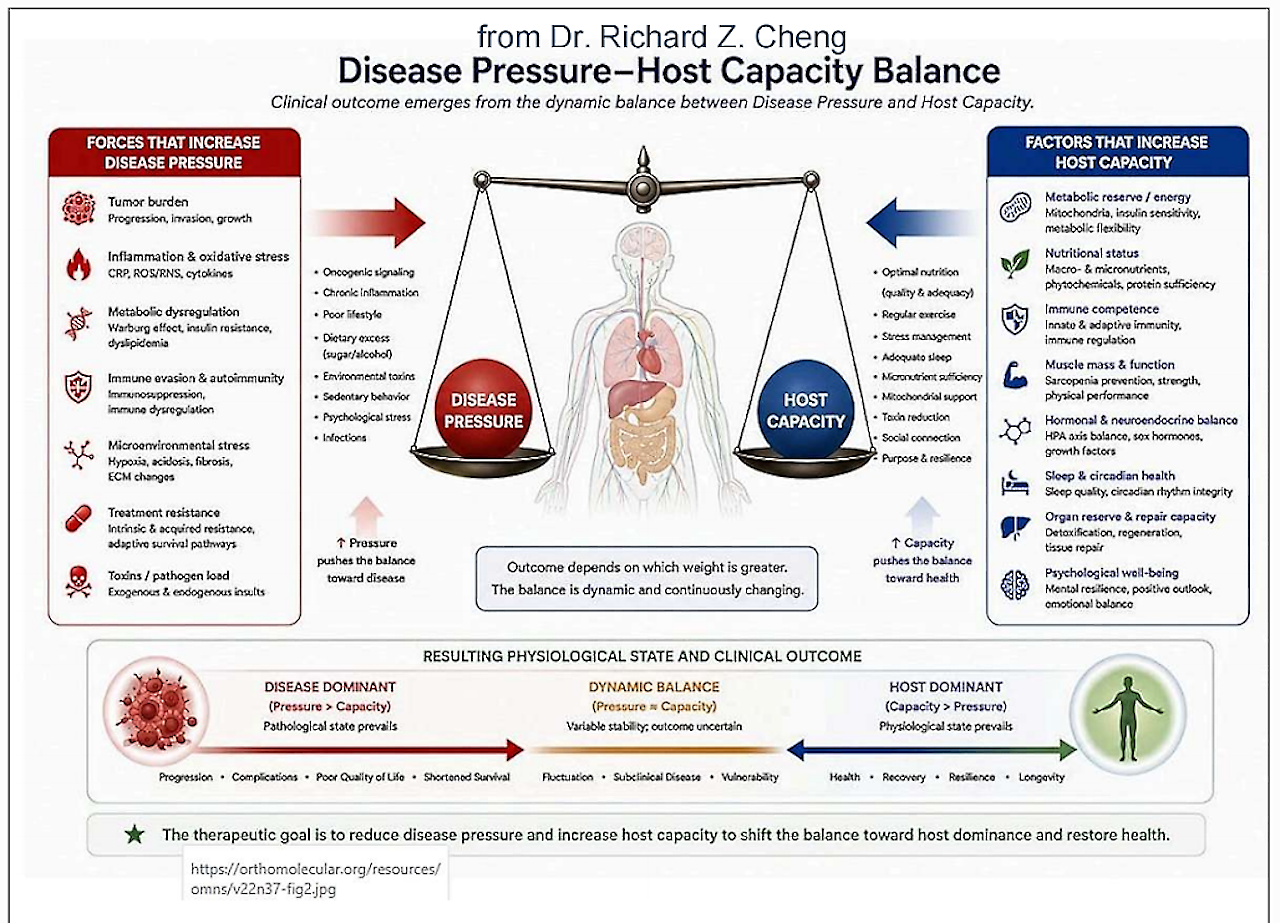
As established in the clinical framework of Dr. Richard Z. Cheng, physiological outcomes do not emerge from acute symptom suppression alone, but from the dynamic balance between Disease Pressure and Host Capacity. While acute Disease Pressure—driven by metabolic dysregulation, chronic inflammation, oxidative stress, and xenobiotic toxin loads—must be evaluated and managed under the direct supervision of your physician, long-term biological resilience demands systematically fortifying Host Capacity. By restoring mitochondrial energy production, immune competence, and cellular nutrient sufficiency, the equilibrium is shifted decisively toward host dominance, clinical recovery, and extended vitality: