The Key Pillars of Orthomolecular Medicine
Foundational Clinical Precepts
Biochemical Individuality
Nutritional and metabolic requirements are uniquely shaped by genetic and epigenetic variation across every executive profile.
Optimal Concentration
Targets therapeutic micronutrient thresholds promoting peak cellular resilience rather than minimal disease-prevention baselines.
Endogenous Molecules
Prioritizes natural substances native to human physiology to restore cellular balance without creating artificial metabolic burdens.
Microenvironment
Ensures critical orthomolecular nutrients efficiently traverse lipid membranes into intracellular compartments where enzymatic work occurs.
Nutrient Synergy
Cofactors and nutrients function cooperatively across biochemical cascades rather than as isolated, disjointed therapeutic compounds.
Root-Cause Resolution
Directs diagnostic focus toward upstream metabolic friction points, bioenergetic blocks, and nutrient deficits instead of palliative masking.
The Orthomolecular Paradigm Slide Deck
Executive Presentation Architecture
Integrated LE Protocols & Root-Cause Principles
- Mitochondrial Optimization: CoQ10 (Ubiquinol), PQQ, and Acetyl-L-Carnitine to sustain oxidative phosphorylation and electron chain transfer.
- Antioxidant Recycling: Alpha-lipoic acid paired with therapeutic ascorbic acid to buffer reactive oxygen species at the inner membrane.
- Substrate Availability: Bioactive B-complex serving as foundational enzymatic cofactors across the Krebs cycle.
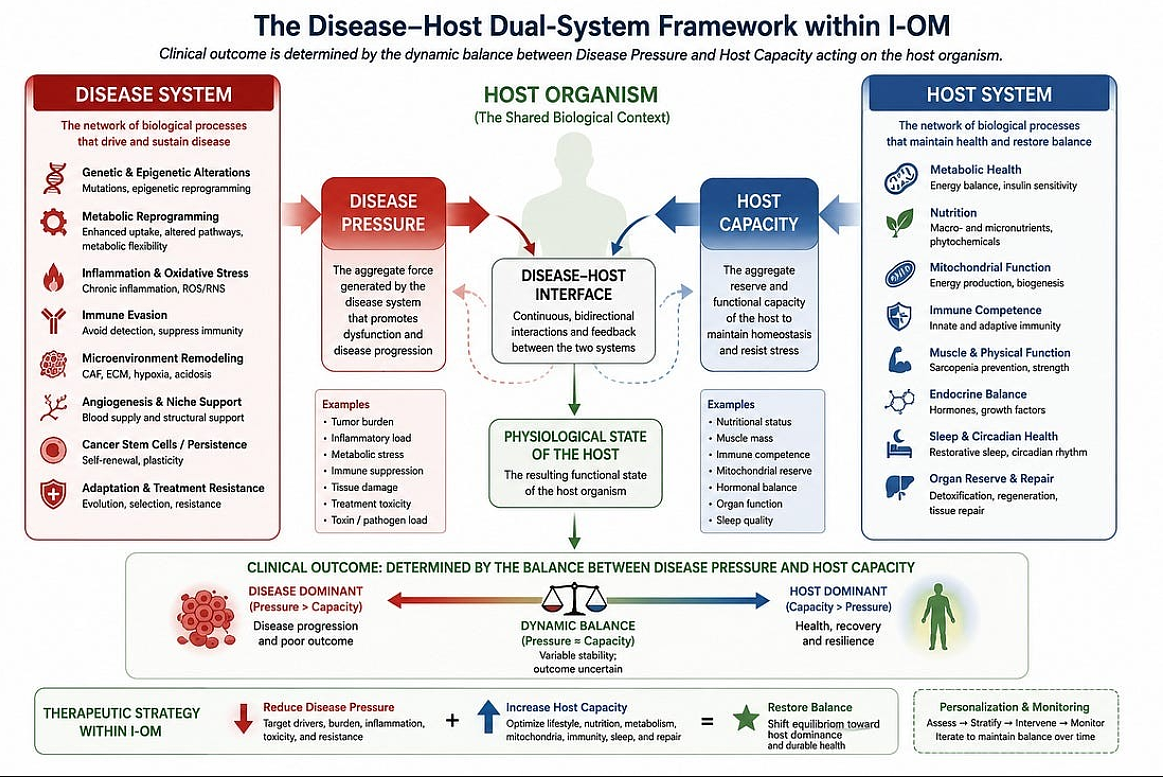
The Disease–Host Dual-System Framework within I-OM
Scientific Architecture Codified by Dr. Richard Z.Cheng
In Integrative Orthomolecular Medicine (I-OM), clinical outcome is not determined solely by the presence of pathology, but by the dynamic balance between Disease Pressure and Host Capacity acting on the host organism. Conventional medicine remains almost entirely preoccupied with attacking disease burden—frequently at the expense of crippling host vitality. The UA-100 Engine implements the paradigm that strengthening Host Capacity is the premier strategy to minimize and dominate the impact of diseases on the host.
The aggregate force generated by pathological processes that drives cellular dysfunction, tissue destruction, and functional decline:
- Genetic & Epigenetic Alterations: Pathological mutations and maladaptive reprogramming.
- Metabolic Reprogramming: Pathogen-driven nutrient uptake and warped bioenergetic pathways.
- Chronic Inflammation & Oxidative Stress: Sustained ROS/RNS production and endothelial erosion.
- Immune Evasion: Suppressive microenvironments shielding damaged cells from surveillance.
- Toxic Pathogen & Treatment Burden: Chemical, environmental, and drug-induced host tissue toxicity.
The aggregate biological reserve and functional capacity of the host organism to maintain homeostasis, repair damage, and resist systemic stress:
- Metabolic Health & Flexibility: Precision insulin sensitivity and stable glucose handling.
- Orthomolecular Nutrition: Complete cellular repletion of essential micro- and macronutrients.
- Mitochondrial Biogenesis & Output: Robust ATP production and intact membrane integrity.
- Innate & Adaptive Immunocompetence: Vigorous immune surveillance without auto-inflammatory overdrive.
- Organ Reserve & Cellular Repair: Active Phase II detoxification, muscle mass preservation, and restorative sleep.